This show features nearly 120 exemplary artistic works from MOSA’s permanent collection, encapsulating India’s living art traditions and exploring the local myths, legends, oral history, sacred mystical texts and folklore inspiring this art. According to renowned art historian and theorist Ananda Coomaraswamy, traditional art forms go beyond outwardly expressing only the sensibility of those who created them to cultivate a sense of the whole civilization that nurtured them.
Viewers encounter the diverse historical periods and cultural contexts shaping 4000 years or more of unbroken artistic traditions here. Artists, who have learned to blend traditional forms with modern aesthetics, are carrying these traditions forward. They adapt tradition to contemporary contexts while retaining much of its symbolic mystical kernel.
Without evoking rasa, or the emotional essence of the creative work, no understanding of Indian aesthetics is complete. The Natyashastra, an ancient Sanskrit treatise on the arts considered the canonical text of Indian aesthetics, centralises rasa’s importance to art. The art displayed here arouses rasa. Their creators broke away from art-school academism to seek out the primaeval vocabulary of inherited traditions. What art connoisseur and historian B. N. Goswamy perceived as time moving cyclically — making bends and loops, turning back on itself— comes to life here.
Kalamkari and other textiles
Kalamkari painted fabric has a 3000-year-old traditional history in Andhra Pradesh, with the oldest surviving pieces dating from the 15th and 16th centuries. It is eulogized for its elaborate narrative style, strong, bold lines and luminous natural dyes. The name’s etymology can be traced to Persian influence: ‘Kalam’ is the Persian word for pen, and the Urdu ‘Kari’ denotes the craftsmanship involved.
This art form is globally admired for the arduous thirty-three-step protocol followed to colour the dye-resistant cotton cloth before it is used as a canvas. The fabric is rinsed twenty times and dried under the strong mid-day sun before it is ready. A burnt tamarind stick is used to draw the initial outlines. A bamboo stylus, the kalam, is then dipped into an iron mordant to etch the black outlines. The red outlines are etched with an alum or madder mordant. The vibrant colours are derived from nature: light yellow from the myrobalan fruit, golden yellow from pomegranate, blue from indigo, grey from alum and green from catechu. The kalam is also used to fill these in.
The temple town of Kalahasti is one of the main centres practising this distinctive genre. Traditionally created for ritual use, Kalamkari themes predominantly derive from the two epics, Ramayana and Mahabharat, and other religious texts. Though the narrative has changed dramatically over the years, the spectacular Kalahasti Ramayana panel displayed here depicts scenes from the myth with narrative panels organised in horizontal registers. We can also see a Biblical subject, the crucifixion of Christ.
Rajasthan Miniatures & Mahavee Swami
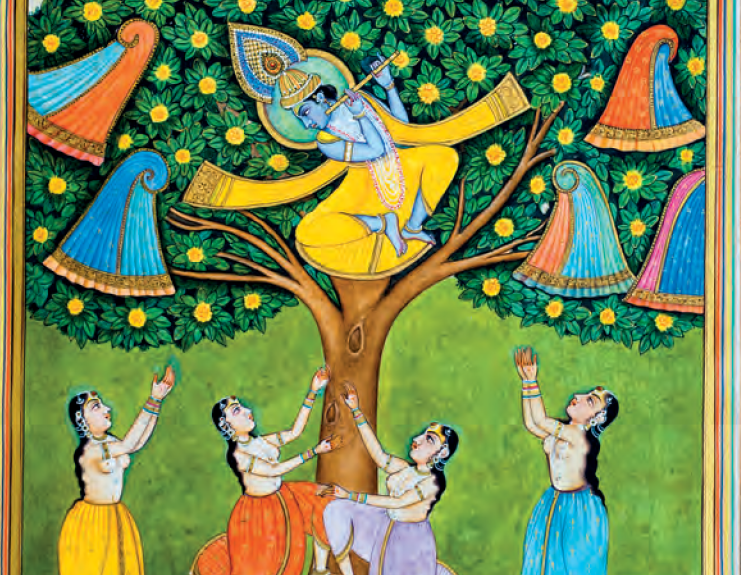
The playful, sensual, boldly coloured miniatures in this section seem to have a deep inner life and a captivating, luminous glow. Drawing inspiration from religious texts, folklore and love poems in Sanskrit and other vernacular narratives like the Gita Govinda, Rasamanjari and Rasikapriya, they create an enchanting world, inviting the viewer in as a seeker, poet, lover, devotee, or art connoisseur.
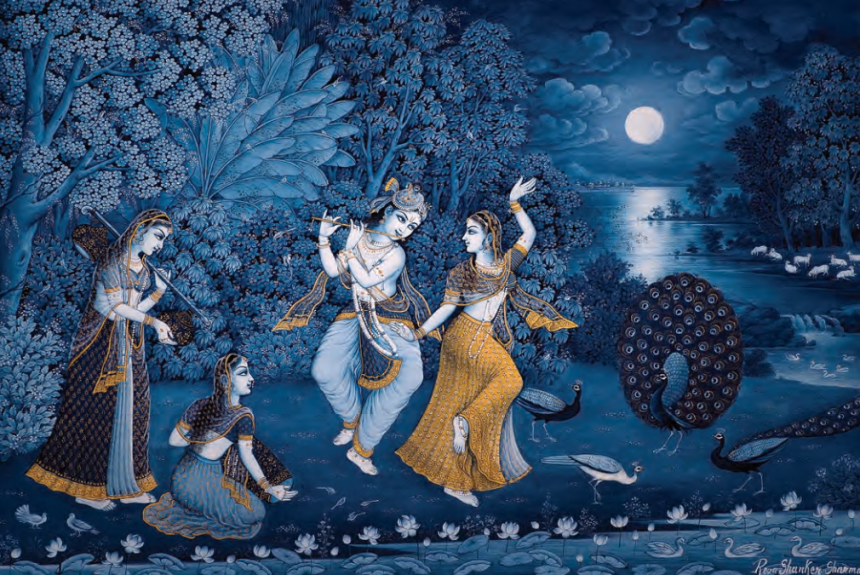
Rajasthan’s royal courts experienced a cultural renaissance in the 16th century. These miniatures were created in royal ateliers in Mewar, Bundi, Kota, Bikaner, Marwar, Jaipur and Kishangarh. They amalgamate the early Rajput style of Jain paintings on palm leaf and paintings illustrating Hindu manuscripts with the Mughal miniature tradition. Finely detailed and naturalistic, these vibrant miniatures foray into Krishna and his consort Radha’s Vaishnava cult, portraying different emotive states through visual poetry. Radha and Krishna dance in moonlight in verdant groves, Krishna watches the gopis fetch water, Radha romances Krishna’s flute; each painting is a self-contained world, like a quatrain of poetry.
Miniature paintings of other deities of the Hindu pantheon were also commissioned. Among these commissions, the seven-volume Mewar Ramayana was illustrated with more than 400 spectacular paintings.
Nearly all the artists displayed here are part of an unbroken generational tradition. In the case of acclaimed artist Mahaveer Swamy, successive generations have enriched this tradition for nearly 400 years.
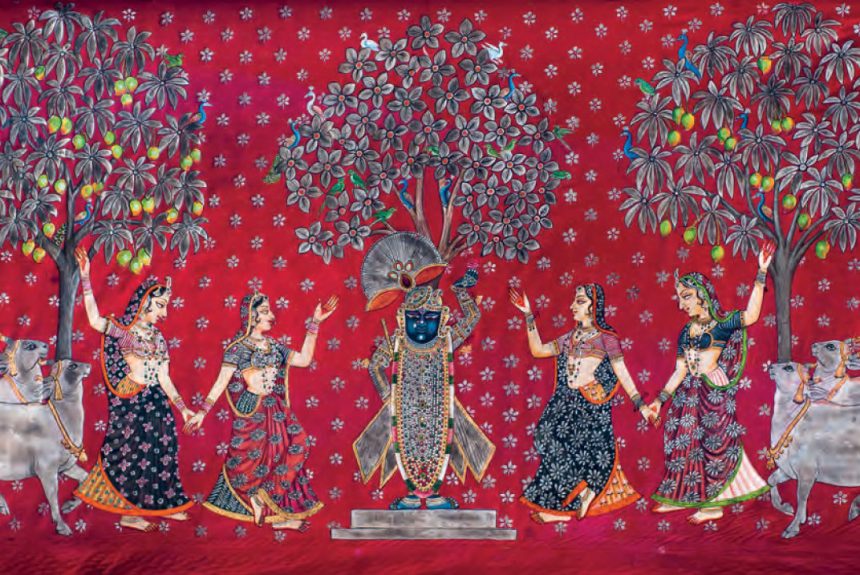
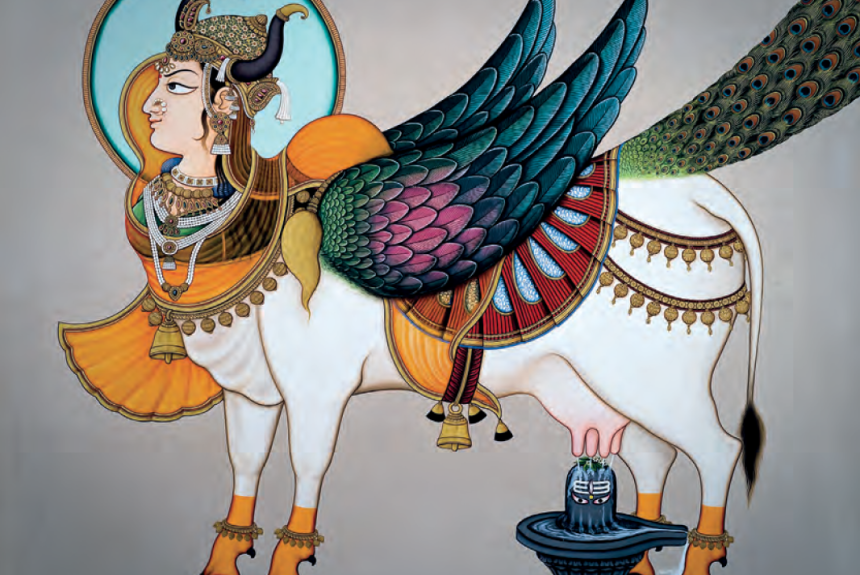
Two iconic exponents of the rich and ornate Pichwai tradition from Nathdwara -Reva Shanker and Shyam Sharma- present paintings that celebrate events in Krishna’s life and highlight the significance of cows in his life. The Nathdwara art tradition is also represented by eminent artists like B. G. Sharma, Indra and J. P. Sharma with evocative visual rendering of religious and mythological themes.
Embroideries
India has a rich and extremely diverse embroidery tradition; it is an art form practised for several millennia. Every region has its distinct repertoire of stitches and figurative and abstract motifs. In the north, many of the Kashida traditions travelled along the Silk Road and absorbed various impressions from the cross-cultural exchange that are still treasured. Meanwhile, the Chamba Rumal embroidery from the hilly state of Himachal Pradesh is deeply influenced by local miniature paintings.
Chikankari —a delicate embroidery from the north, flourishing under Mughal patronage— is another significant tradition. It uses a repertoire of 35 different stitches to create beautiful nature-inspired designs. Zardozi, highly embellished, executed with silver and gold metal wires and mirrored glass incorporated threadwork, is distinctive of the western region. In the south, the nomadic tribes’ colourful and geometric Banjara embroidery is well-reputed.
Four embroidered works are presented here. Two are from the western region: a scene from the Mahabharat and the image of Krishna in the Nathdwara style. The other two are from the eastern region known for its Sujani and Kantha embroideries, part of India’s ancient quilting tradition. The Tree of Life and the scene from Mahabharat are Kantha pieces created by women artists from Bengal. These artists also embroider visual images from the quotidian aspects of everyday life and their intimate repository of personal and collective memories.
South India
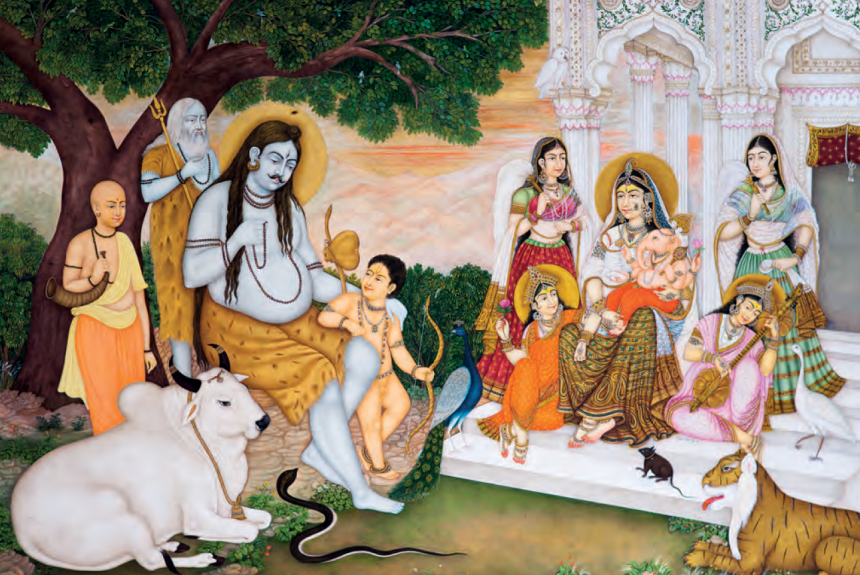
The southern artists presented here selected their subjects from Hinduism’s ancient scriptural heritage. Hinduism is polytheistic, with many gods and goddesses. Most depictions look like humans with physical traits setting them apart. They wear or carry special objects emblematic of their superior power. The multifaceted Vishnu, creator and preserver of the cosmos, is identified by a wheel called a chakra, the mace, conch shell and the lotus, the emblem of transcendence.
Part of the rich and revered Vaishnava tradition, Vishnu and his manifestations continue to inspire artists. Shiva is similarly inspirational as Nataraja, or the lord of dance, set within a flaming halo, his right foot trampling a dwarf-like figure who represents the demon of illusion or darkness leading mankind astray. The myth of Ardhanarishvara, the composite form of Shiva and his female consort Shakti, appearing in ancient Puranic scriptures, is another iconic image of Indian art.
Four celebrated artists are displayed in mediums like pencil, acrylic and watercolour: Srinivasa Reddy, G. L. N. Simha, Manivelu and Drdha Vrata Gorrick, an artist born and raised in the US but spellbound by Indian temple art’s beauty and semiotics.
Madhubani
This vibrant and deeply evocative art form is inspired by the forests spread across the Himalayan foothills in the Mithila region, rich in stories, folklore, myths and legends. Its origin stretches back to antiquity, but the murals on mud walls washed with cow dung were discovered only after a cataclysmic earthquake shook the area in 1934. In the wreckage of destroyed homes, a few symbolic and mythological motifs drawn and painted for weddings, festivals and religious rituals survived as a testament to the unique art tradition that eluded most art historians. More than three decades later, a severe drought resulted in the first spate of painting on paper in a desperate attempt to find a source of income.
Practised primarily by women artists, the artwork is created with intricate lines made with fine-nibbed pens or using a bright colour palette with fewer lines. The ancient tattoo art has also inspired this region’s artists as have the Tantra tradition’s mystical elements. The colours used are symbolic, with red representing love and passion, blue for divinity, yellow for fertility and green for nature.
Bharti Dayal’s works on display add a contemporary twist to the old themes.
Mysore and Tanjore Painting
Celebrated for its refinement, sober palette and scrupulous attention to detail, the Mysore school of painting is a treasured part of South India’s classical heritage. Its genesis can be traced to the mural art of the Vijayanagar empire (1336-1565 AD). The maharajas of Mysore during the 17th to 19th centuries favoured this style.
The art presents a mix of religious themes and scenes from courtly life. It was created mostly on paper board made of paper pulp dried in the sun, smoothened with quartz pebbles or cloth pasted on a wooden board using a paste of dry white lead mixed with gum and a touch of gruel. Relief art, known as gesso, partially covered in gold leaf, was one of the telltale signs of this school. The tradition has endured through the ages, even as artists have begun using paper and mediums like acrylic and oil.
The relatively subtle use of gesso distinguishes Mysore painting from the Thanjavur style, also known as Tanjore painting. Embellished with lavish gold work and precious and semi-precious stones, the visual vocabulary of Tanjore painting is more ornate. The Maratha kings patronised this style. It also owes its origin to the remarkable cultural efflorescence during the reign of the Vijayanagar kings. When the region came under colonial rule, the Company School of Painting influenced artists. The medium changed to gouache and watercolour on paper even as they continued to explore religious themes and dabble in portraiture.
The paintings in this section, of unknown provenance, are from Manglam Arts, an institution promoting antique Tanjore paintings. The Mysore paintings are by renowned contemporary artists like Anand, Sreehari and Sridhar Rao.
Jain Art
One of India’s oldest religions, Jainism, shares a few features with Buddhism and Hinduism but has its separate key texts, rituals, belief systems and history. Originally painted on palm leaf, the abstract religious imagery of Jain Art was used as a mystical aid in the quest for enlightenment. Among the manuscripts, Kalpasutra is prominent, with exquisite squarish panels illuminating the lives of Jain saviors, known as the Tirthankaras.
Noted for their rich colour palette with a discernible Persian influence, the lavish use of golden yellow and an intense blue made of lapis lazuli sets apart the Jain paintings. No surviving Jain mandala or cosmogram predates the 14th century; earlier renderings were made on perishable material. The Rsimandala is significant— a ritual diagram developed in the still-revered medieval period.
The Jain art presented here is from the Artists’ Studio and the collection of acclaimed contemporary artist Manish Soni.
Pattachitra
The Pattachitra of Odisha, a state in East India, is associated principally with the Jagannath temple at Puri and temples in Bolangir, Sambalpur and Ganjam. Part of the tradition of pigment-painted cloth for ritual use, the paintings double as substitute icons when the wooden images of the deities are removed for repainting. Over time, the repertoire has expanded to include episodes from the epics, scenes from Krishna’s life, the manifestations of Vishnu and local religious myths and legends.
The preparation of the ritual cloth and the pigments is a laborious task. A coarse, white cloth of double thickness is repeatedly treated with gum prepared with tamarind seeds. A coat of soapstone powder is applied before burnishing the surface with stone. Pigments are sourced from nature: conch shells, flowers, betel leaves, stones, and oil- based soot. The surface is glazed with lacquer over a charcoal fire for the final finish. The story comes to life in vertically arranged frames with a brush made of pine fibre or animal hair.
This spectacular living tradition is represented here by Chandrashekhar and Narayan Das, and Rabindra Mahapatra.
Tribal Sculptures
The tribal sculptures displayed were created using Dhokra, the indigenous lost wax method of bronze sculpting. The technique was earliest recorded in sites of the ancient Indus Valley civilisation —Harappa, Chanhu-daro and Mohenjo-daro. Excavations unearthed lost wax bronze figures, the most prominent being the statuette of the dancing girl. It continues as a living tradition in Central and Eastern India’s tribal belt.
The sculptures are inspired by local mythology and folklore, featuring animals, birds, trees, and local deities worshipped to ward off poor harvests, epidemics, and severe droughts.
One of the tribal sculptures displayed in the gallery is by an unknown artist. The others have been created by Jaidev Baghel, a renowned artist from Chhattisgarh’s Bastar district, who experimented with both the scale and form of the lost-wax-casting technique. His practice is embedded in his cultural heritage, and the family tradition passed on by his father, the eminent sculptor Sriman Baghel. Jaidev is famous for his signature style of elongated torso and limbs.
Warli
The traditional Warli artists were women. They painted fertility symbols on their cow- dung-coated mud walls with rice paste using a bamboo stick as brush. Warli’s ubiquitous chawk pattern differed from village to village but consistently combined three primary shapes— the circle, triangle and square representing the sun, mountain and earth. The paintings also depicted Waghoba, the tiger god, Kansari, the goddess of seeds, and Palghat, the earth goddess. Ancestors symbolising the vital link between the past and future were also depicted, along with the joyous dance of men and women in concentric circles, their arms interlocked.
Warli is no longer the domain of women artists alone. Two untitled paintings displayed in the gallery are by male artists: Anil Chaitya Vangad and Balu Ladakya Dumada. The other two paintings are by iconic artist Jivya Soma Mashe, the first Warli artist to paint on paper and canvas using poster colours. Mashe went beyond painting Warli myths and stories to painting life as he saw it. From the monsoon wedding of frogs to fishing operations, farmers in paddy fields, railways being built, bicycles, and bullock carts— he painted whatever gripped his consciousness. His evocative painting ‘My Village’ uses clay and cow dung on cloth.
Gond
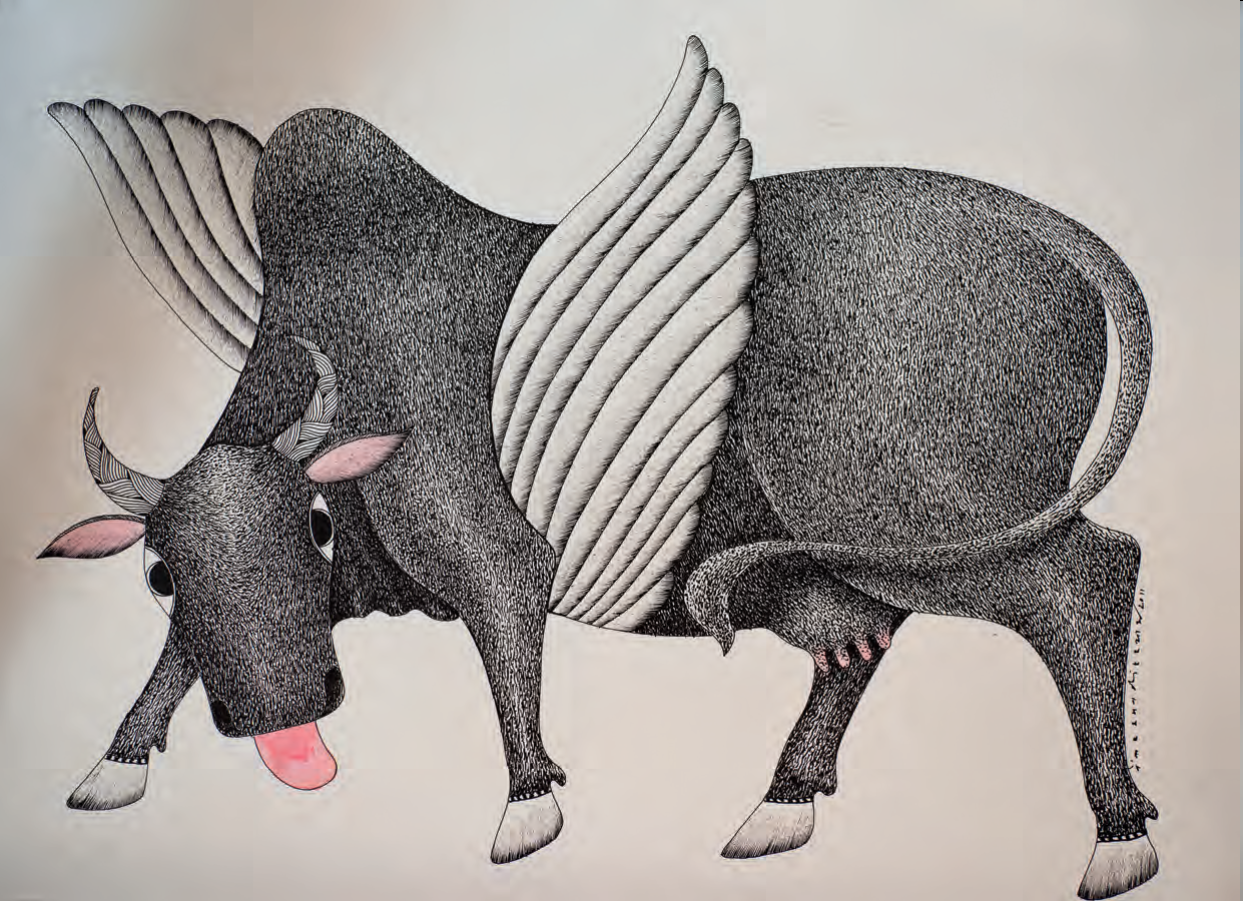
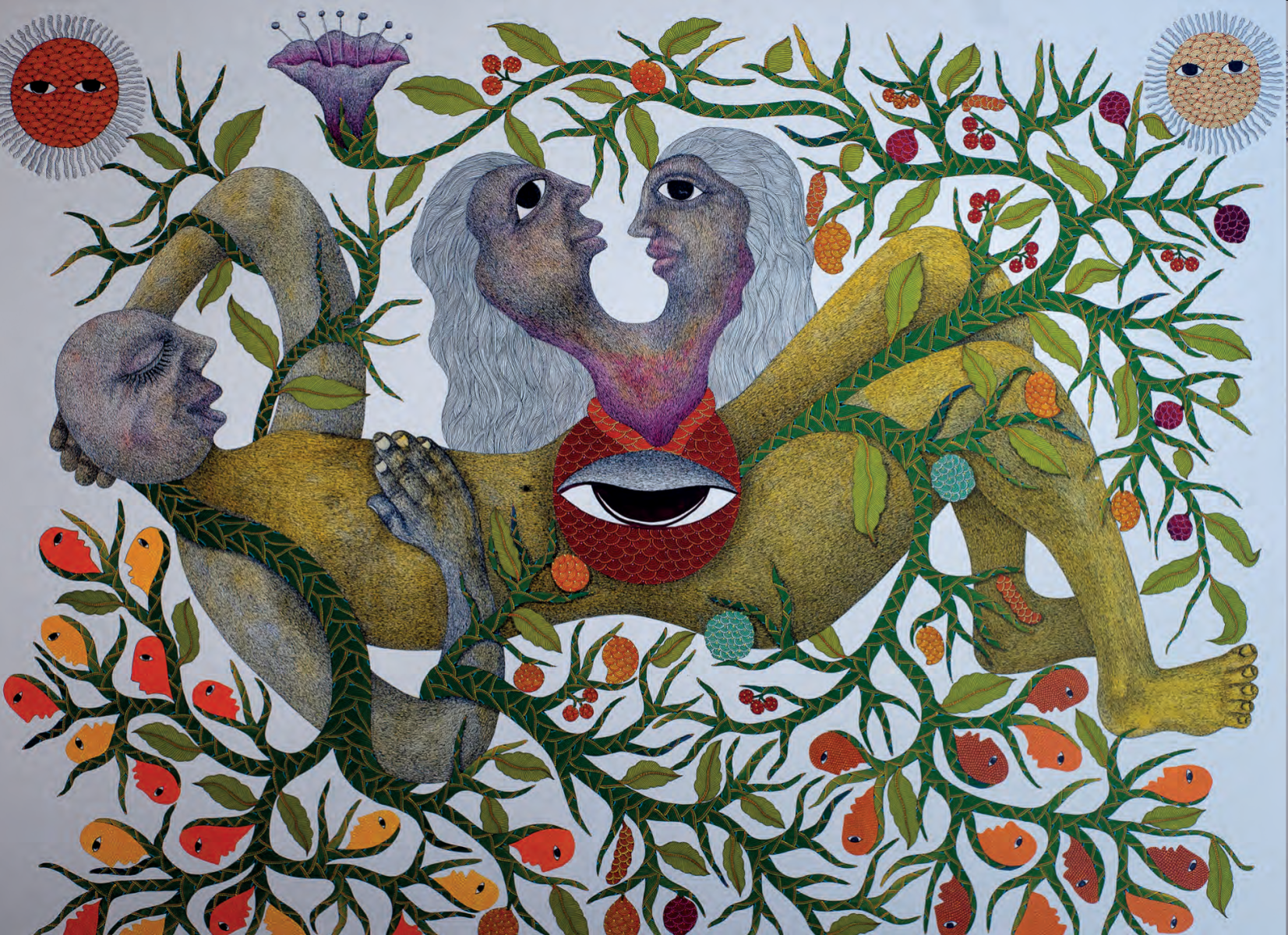
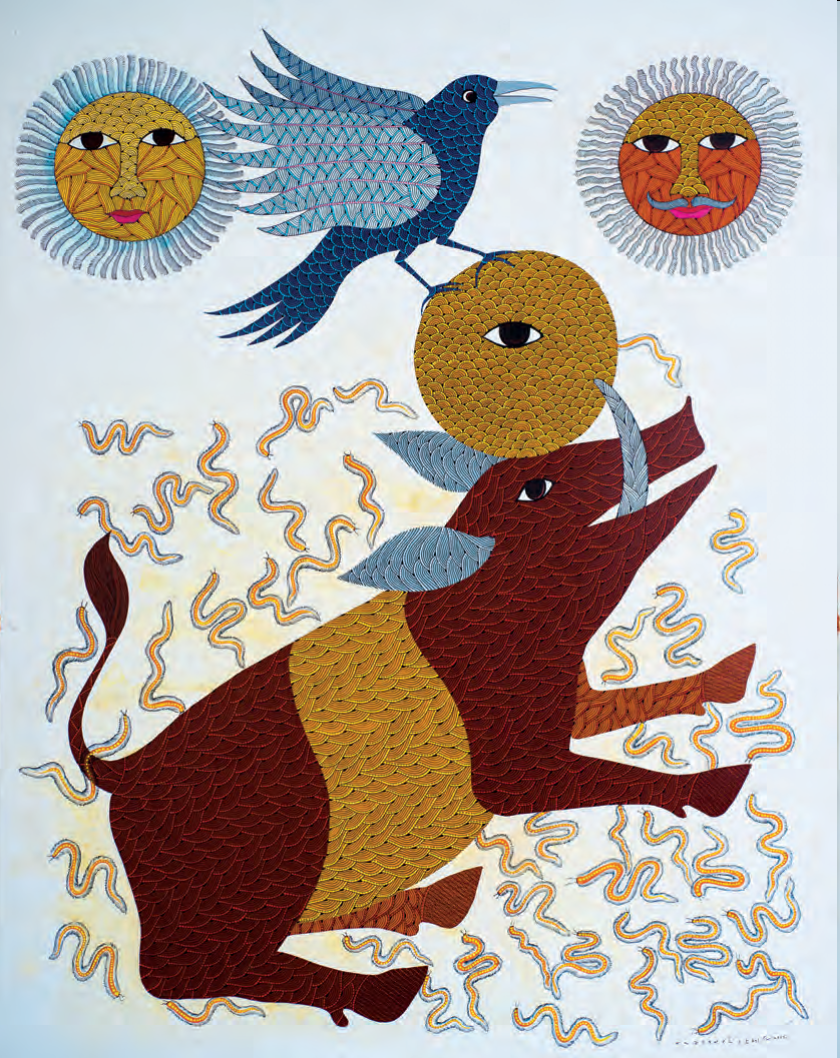
The mesmerising, esoteric paintings of Gonds, an ancient tribe from Central India, have taken over the contemporary art world. Bards from the Pardhan community popularised the art form when they began giving visual shape to their songs and stories about Gond myths, folklore and legends. They painted mystic, symbolic patterns of repetitive lines, squiggles, tiny dots, circles, dashes and strokes using natural pigments, with brushes improvised from tree bark fibre on walls and floors freshly coated with cow dung.
Their amazing interpretation of their cosmos remained hidden from the larger world until eminent contemporary artist, poet and writer J. Swaminathan discovered artist Jangarh Singh Shyam. Swaminathan encouraged Jangarh to create large murals in celebrated urban art spaces. Jangarh’s experimentation with innovative new ideas, colours and textures received extraordinary national and international acclaim. The Jangarh Kalam, or signature style, inspired a community of Gond artists to use acrylic and oil on canvas and paper, breaking conceptual and experimental boundaries while still embracing their tribal identity and unique mystical relationship with nature. Artist Venkat Shyam, whose work is displayed here, is one of the leading practitioners of this unique kalam.
Kalam Patua
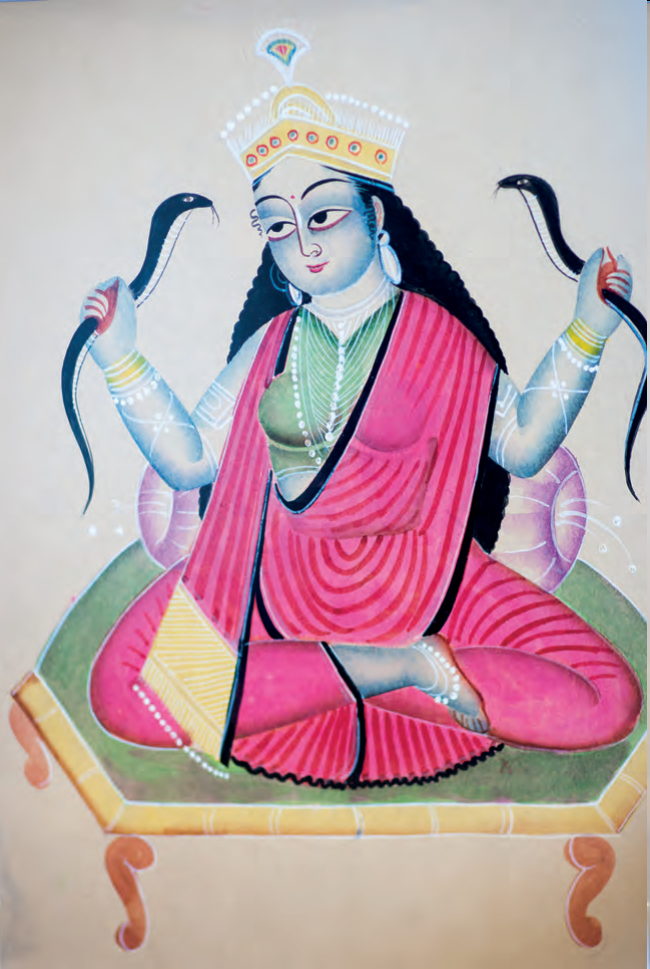
One of the last remaining exponents of Kalighat scroll painting of Bengal, Kalam Patua received no formal training in the quaint tradition that developed in the 19th century. Beginning with painted images of gods and goddesses, the Kalighat Patua artists of Calcutta began to draw inspiration from the quotidian subjects of their urban milieu, adding an element of caricature and satire while critiquing their society and politics— using bright watercolours and sweeping brush strokes. Kalam Patua’s body of work draws from that tradition. The paintings in this section carry religious iconography reminiscent of early Kalighat paintings, reflecting his diverse oeuvre.
Sanjhi of Mathura
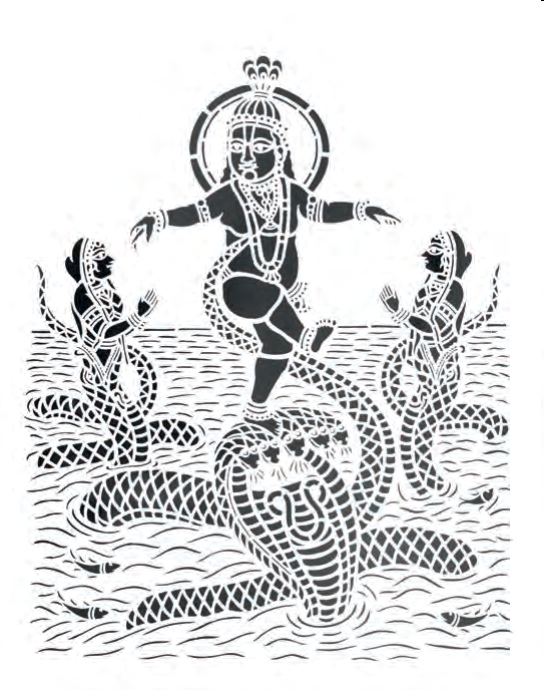
Expressing the artist’s exuberant love for the divine, Sanjhi is a ritualistic stencilled paper art form practised in Vraj-Bhoomi, the land associated with worshipping the blue god, Krishna. Yamuna, the river flowing through this land, is integral to its iconography.
The art originated in China and Egypt between 3000 and 2000 BC. It is unclear when it travelled to India, but it evolved into a refined and coveted art form by the 16th century, incorporating elements of Mughal iconography. According to folklore, its origin lies in antiquity, when Krishna’s consort Radha adorned the floors and walls of her home with designs made of coloured powder, crushed flowers and mirror pieces to entice her beloved.
The art moved from homes to temples, with images of Krishna deified in other Vaishnava temples beyond Vraj-Bhoomi, like Nathdwara in Rajasthan. Motifs are composed and drawn, then cut into stencils with specially designed scissors on handmade paper or banana leaf. The stencils are then used to create octagonal, square, rectangular or circular images. Artists, part of a linear tradition spanning many generations, executed the Sanjhi art presented here. Krishna wrestles with Kaaliya, a demonic cobra, and lifts Mount Govardhana like an umbrella over his cowherd friends and their cattle.